
The Silent World: Understanding Your Deaf Dog's Experience
Discover what life is really like for deaf dogs, explore sensory compensation research, and learn effective communication and training tips for your silent companion.
BEHAVIORLIFESTYLE
DLC of Well Planned Pawrenthood
10/17/202511 min read


The Silent World: Understanding Your Deaf Dog's Experience
What it's really like for deaf dogs, sensory compensation research, and the surprising advantages of their silent world
When I first discovered Jemma was completely deaf, I panicked. Not because I thought she couldn't live a full life—but because I realized how little I understood about the rich, complex world she already inhabited. At twelve weeks old, she'd been navigating her silent universe with the confidence of a seasoned explorer, reading micro-expressions I didn't even know I was making and detecting vibrations through her paws that I couldn't feel through my entire body. That first week taught me something profound: her world wasn't smaller than a hearing dog's—it was simply different. And in many ways, beautifully enhanced.
The Science Behind Sensory Compensation
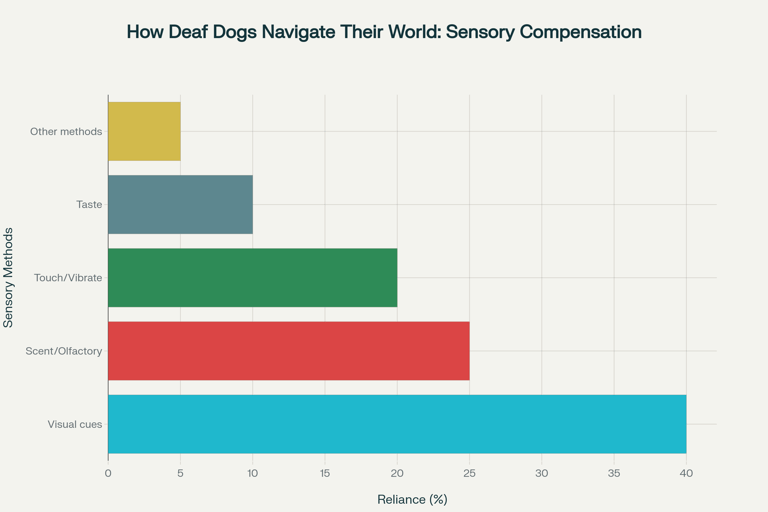
Recent research has revolutionized our understanding of how deaf dogs experience their world. Far from being diminished, their sensory universe becomes specialized and enhanced. Studies show that congenitally deaf dogs develop what researchers call "cross-modal plasticity"—essentially rewiring their brains to extract more information from their intact senses.
Dr. Bavelier's groundbreaking work on deaf individuals reveals that deaf subjects show enhanced peripheral visual attention and faster processing of visual motion. This same phenomenon occurs in deaf dogs, who demonstrate remarkably heightened visual awareness compared to their hearing counterparts. They notice subtle movements, changes in lighting, and visual cues that hearing dogs might miss because they're focused on auditory information.
How Their Brains Adapt
When hearing is absent from birth, the brain regions that would typically process sound don't simply go dormant—they get recruited for other sensory processing. In deaf dogs, this means:
Enhanced Visual Processing: The auditory cortex becomes involved in processing visual information, creating what researchers describe as a more robust visual attention system.
Improved Tactile Sensitivity: Research on deaf humans shows significant changes in how touch information is processed, with enhanced sensitivity to vibrations and tactile discrimination. Deaf dogs show similar adaptations, becoming exquisitely sensitive to ground vibrations, air currents, and physical touch.
Scent Specialization: While dogs already have incredible olfactory abilities, deaf dogs often develop even more refined scent discrimination skills, using smell as a primary communication and navigation tool.
The Deaf Dog Experience: What Research Tells Us
Do Deaf Dogs Know They're Different?
One of the most common questions from new deaf dog owners is whether their pup realizes they're different. The research-backed answer might surprise you: deaf dogs don't conceptualize deafness the way humans do. They don't think "everyone stopped talking to me" or feel like they're missing out.
Dogs lack the cognitive complexity for that kind of multi-step thinking. Instead, they simply adapt to the world as they experience it. Congenitally deaf dogs—those born without hearing—never know that they're "missing" anything. Their world has always been visual, tactile, and scent-based.


Dogs who lose hearing gradually often transition so seamlessly that owners don't realize the change until it's quite advanced. This adaptability speaks to dogs' remarkable resilience and their natural reliance on multiple sensory channels for communication.
Enhanced Sensory Abilities: The Research
Multiple studies confirm that deaf dogs develop compensatory enhancements in their remaining senses:
Visual Acuity: Deaf dogs show increased attention to visual stimuli, particularly peripheral movement. They become experts at reading body language, facial expressions, and environmental changes that hearing dogs might overlook while processing auditory information.
Vibrational Sensitivity: Dogs naturally detect ground vibrations through specialized receptors in their paws and joints. Deaf dogs develop this ability to an extraordinary degree, feeling footsteps, door closings, and vehicle vibrations from impressive distances.
Scent Communication: Research suggests deaf dogs may develop enhanced olfactory processing to compensate for lost auditory communication channels. They become more attentive to scent marking, pheromones, and environmental odors that provide social and navigational information.
Understanding Breed Predispositions
Deafness in dogs is often genetic, particularly associated with pigmentation genes that affect coat color. The connection between white coat coloration and deafness occurs because the same cells that produce pigment in the coat also help develop the inner ear structures responsible for hearing.
Dalmatians lead the statistics with nearly 30% of puppies born with some degree of hearing loss. This high rate stems from their distinctive spotted coat pattern, which is genetically linked to inner ear development issues. Other breeds with significant predispositions include Australian Cattle Dogs, English Setters, and Bull Terriers.
Interestingly, research shows that dogs with more pigmented coats—including those with patches or non-standard colorations—have significantly lower rates of congenital deafness. This genetic connection explains why some breed standards inadvertently select for deafness by prioritizing certain coat patterns over hearing health.
Communication and Training: Their Unique Advantages
Contrary to old misconceptions, deaf dogs are often easier to train than hearing dogs. This seeming paradox makes sense when you understand their enhanced focus and specialized learning style.
The Visual Learning Advantage
Research by trainer and behaviorist Paul Klein reveals that deaf dogs excel at visual communication because they're naturally more attentive to body language and facial expressions. Without auditory distractions, they develop laser focus on their handler's visual cues.
Studies comparing dogs' responses to visual versus auditory commands found that even hearing dogs often respond better to gestures than verbal cues. This means deaf dogs are simply maximizing a communication channel that all dogs prefer.


Advanced Communication Techniques
Professional trainer Carolina Jardim's groundbreaking work with deaf dogs demonstrates that their learning capacity extends far beyond basic hand signals. Her research with Milka, a deaf Dalmatian, proved that deaf dogs can learn:
Lip reading: Responding to mouth movements for words like "sit," "down," and "come"
Facial micro-expressions: Reading subtle emotional cues and responding appropriately
Mirror communication: Understanding commands given through reflections
Advanced gesture sequences: Following complex multi-step visual instructions
This isn't just impressive—it's scientifically significant. These dogs are demonstrating cognitive flexibility and communication skills that challenge our understanding of canine intelligence.
Building Your Visual Vocabulary
The key to successful deaf dog communication lies in consistency and creativity. Start with basic signs but don't limit yourself to standard gestures:
Essential Basic Signs:
Attention/Watch Me: Point to your eyes or use a gentle hand wave
Sit: Flat palm moving upward
Down: Flat palm pressing downward
Stay: Open hand held like a "stop" sign
Come: Arms spread wide, then brought to chest
Advanced Communications:
Good/Yes: Thumbs up or open-hand flash
All Done/Finished: Hands wiping together
Wait: One finger raised
Go: Pointing in desired direction
The beauty of deaf dog training is that you can create your own signs that work for your household. Jemma responds to signs I invented specifically for our routines—like a circular motion for "find your toy" and tapping my temple for "think" (her cue to problem-solve puzzle feeders).


Technology That Bridges the Gap
Modern tools can enhance communication with deaf dogs, though they're supplements to—not replacements for—consistent visual training.
Vibrating Collars: The Science and Safety
Vibrating collars designed specifically for deaf dogs use gentle pulses to get attention without causing stress or discomfort. Research by Whole Dog Journal found that properly introduced vibration collars can be highly effective for recall training and attention-getting.
Key findings from vibration collar studies:
Success rates of 80% or higher for trained dogs
Most effective when paired with positive reinforcement
Should be introduced gradually, starting with body exposure before neck use
NEVER use shock collars—vibration-only models are both humane and effective
Recommended Budget-Friendly Option: WOLFWILL Vibration Collar ($40-60) offers multiple intensity levels and waterproof design.
Premium Option: Educator PG-300 Pager ($189) provides professional-grade reliability with half-mile range.
Alternative Communication Tools
Flashlights and Laser Pointers: Excellent for distance attention-getting, especially useful for recall training in large spaces or low-light conditions.
LED Collar Lights: Not just for safety—the flashing patterns can become communication signals. Some deaf dogs learn to associate different flash patterns with different commands.
Puzzle Toys and Scent Work: Enhance their natural problem-solving abilities while providing mental stimulation that doesn't rely on auditory cues.
The Behavioral Reality: Myths vs. Facts
Extensive research by Dr. Valeri Farmer-Dougan and colleagues compared behavioral characteristics of deaf dogs versus hearing dogs, revealing surprising findings:
What Research Actually Shows
Aggression Levels: Deaf dogs scored lower on aggression measures than hearing dogs. This contradicts the persistent myth that deaf dogs are more aggressive or unpredictable.
Trainability: No significant differences in learning ability or response to training. In fact, many trainers report deaf dogs learn visual cues faster than hearing dogs learn verbal commands.
Behavioral Challenges: Deaf dogs showed slightly higher rates of inappropriate chewing and excessive barking, likely due to differences in sensory input rather than behavioral problems.
Social Integration: Deaf dogs adapted well to multi-dog households and showed no increased difficulty with social interactions.
Understanding Their Unique Needs
Startle Response: This is the most important behavioral consideration. Deaf dogs can be startled when approached from behind or awakened suddenly, potentially leading to defensive reactions. Solution: Always approach from their line of sight and wake them gently with vibration (tap the floor) rather than touch.
Separation Anxiety Differences: Research suggests deaf dogs experience separation anxiety differently than hearing dogs. Rather than "being left alone," their anxiety stems from "where did you go?" when they look up and can't find their person. Solution: Always "announce" your departures with a consistent visual cue.
Communication Frustration: Without the ability to hear their own vocalizations, some deaf dogs develop unique barking patterns or increased vocalization. Solution: Teach visual "quiet" signals and ensure adequate mental stimulation.
Daily Life: The Practical Reality
The Surprising Benefits
Living with Jemma has revealed unexpected advantages to sharing life with a deaf dog:
Peaceful Sleep: Thunderstorms, fireworks, and neighbor noise don't disturb their rest (or yours). While Titan spends July 4th hiding under furniture, Jemma snoozes peacefully through the entire fireworks display.
Focused Attention: Without auditory distractions, deaf dogs often develop intensely focused relationships with their handlers. The eye contact and attention they provide can be remarkably intimate and rewarding.
Calm in Chaos: Busy environments that overwhelm hearing dogs—like dog parks or training classes—often don't faze deaf dogs who aren't processing the auditory overload.
Practical Considerations
Safety First: Deaf dogs require extra vigilance around traffic, other animals, and potential dangers they can't hear approaching. Secure fencing and leash training become non-negotiable.
Visitor Protocol: Educate guests about approaching from the front and not startling your dog. A simple sign at your door explaining your dog's deafness can prevent uncomfortable situations.
Emergency Planning: Consider how you'll alert your deaf dog to dangers like smoke alarms or emergency situations. Flashing lights or vibration systems can be lifesavers.
Social Dynamics and Multi-Dog Households
Research on how deaf dogs interact with hearing dogs reveals fascinating insights:
Hearing Dogs Don't Automatically Accommodate: Despite being able to sense something different about their deaf housemates, hearing dogs typically don't modify their communication style. However, many deaf dogs become excellent at reading the body language of their hearing companions, using them as "hearing guides" in some situations.
Pack Integration: Deaf dogs integrate successfully into multi-dog households with proper introduction and management. Their different communication style rarely causes lasting social problems, though initial adjustment periods are common.
Learning from Others: Many deaf dogs pick up on household routines by watching other pets, essentially using their housemates as living alarm clocks for meal times, walks, and activities.
When Dogs Lose Hearing Later in Life
Not all deaf dogs are born that way. Senior hearing loss is increasingly common, and dogs who lose hearing gradually often transition more easily than their owners expect.
The Gradual Transition
Dogs losing hearing slowly have time to develop compensatory strategies. They often maintain normal routines so successfully that owners don't realize the change until hearing loss is quite advanced.
Early Signs of Hearing Loss:
Sleeping through normally arousing sounds
Not coming when called from another room
Increased startle response when touched unexpectedly
Changes in barking patterns or vocal responses
Less response to environmental sounds (doorbells, vacuum cleaners)
Helping Senior Dogs Adapt
Use Their Existing Visual Cues: Most dogs already know some hand signals or respond to gestures. Strengthen these existing associations while their hearing diminishes.
Maintain Routines: Consistent schedules help deaf dogs navigate their days without relying on auditory cues.
Introduce New Communication Gradually: Add visual signals to existing verbal commands before hearing loss is complete.


Frequently Asked Questions
Do deaf dogs make good pets for families with children?
Research suggests deaf dogs can be excellent family pets with proper preparation. The key consideration is teaching children about the startle response—always approaching from the front and being gentle when waking or surprising the dog. Many deaf dogs become intensely bonded with their families and show lower aggression rates than hearing dogs.
Are deaf dogs harder to train than hearing dogs?
Studies consistently show that deaf dogs are often easier to train than hearing dogs. They're naturally more focused on visual cues and less distracted by environmental sounds during training sessions. However, they do require consistency in visual communication and may need different management strategies.
Can deaf dogs hear anything at all?
Some deaf dogs retain partial hearing, particularly for higher or lower frequencies. Dogs with partial deafness might respond to very loud sounds, vibrations transmitted through surfaces, or sounds at the extreme ends of their hearing range. However, truly deaf dogs rely entirely on their other enhanced senses.
Will my deaf dog know when I'm upset or happy?
Absolutely—possibly better than hearing dogs. Deaf dogs become exceptionally skilled at reading facial expressions, body language, and emotional cues that hearing dogs might miss while processing auditory information. Many deaf dog owners report their pets are incredibly in tune with their emotional states.
Do deaf dogs bark differently?
Yes, deaf dogs often have distinctive barking patterns. Without auditory feedback to modulate their volume, they may bark louder or with unusual tones. Some deaf dogs develop what researchers call "excitement-frustration" barks during play or social interactions.
Can deaf dogs live off-leash safely?
This requires extremely careful consideration and extensive training. While some deaf dogs achieve reliable recall using vibrating collars and visual cues, the safety risks are significant. Most experts recommend secure fencing and leash management as safer alternatives.
The Future of Deaf Dog Research
Emerging research continues to reveal the remarkable adaptability of deaf dogs. Scientists are exploring:
Genetic Interventions: Research into the specific genes causing hereditary deafness may eventually allow prevention through selective breeding.
Enhanced Communication Technology: Development of more sophisticated visual and tactile communication devices specifically designed for deaf dogs.
Neuroplasticity Studies: Investigation into how deaf dogs' brains reorganize and enhance processing of non-auditory information.
Behavioral Interventions: Research into optimal training methods and environmental modifications to maximize deaf dogs' quality of life.
Living the Silent Life: A Personal Reflection
Seven years with Jemma has taught me that her deafness isn't a limitation—it's a different way of experiencing the world. Where hearing dogs live in a soundscape of constant audio information, she inhabits a rich visual and tactile universe that most of us barely notice. She feels conversations through floor vibrations, sees emotional subtleties in facial expressions, and smells stories that hearing dogs miss while processing auditory distractions.
The most profound lesson she's taught me is about presence. Without the ability to hear me call from across the house, she's learned to check in regularly, creating moments of eye contact and connection that I now treasure. Her attention isn't divided by sounds I can't even detect—when she looks at me, she's completely, utterly focused.
Her world isn't smaller than a hearing dog's world. It's simply different. More visual, more tactile, more immediate. And in our noisy, chaotic modern environment, there are times when I envy the peace of her silent universe.
The research confirms what every deaf dog owner discovers: these remarkable animals don't just adapt to their sensory differences—they excel because of them. They've taught us that communication transcends sound, that attention can be deeper when it's undivided, and that love doesn't require volume—just understanding.


About the Author: This article combines certified professional training methods with peer-reviewed research and real-world experience from Planned Pawrenthood's deaf dog expertise. All training techniques are based on positive reinforcement principles supported by veterinary behaviorists. Last updated: October 2025.
Resources
Your go-to hub for pet parenting tips.
Unleash Your Inner Pawrent
© 2025. All rights reserved.
Tiny paw-print note: We may earn on Amazon links—no extra cost to you, but it does fund our dogs’ ever-growing tennis ball obsession.